
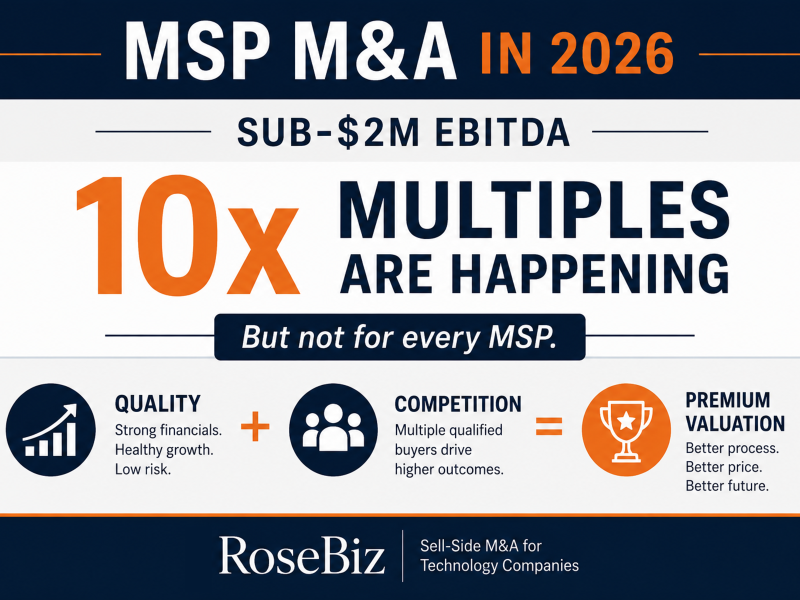
Axial recently released its Lower Middle Market M&A Outlook for the second half of 2026, and much of what they are reporting lines up with what I am seeing in the market as a technology M&A advisor, particularly for MSPs. This year has remained very strong for MSP M&A. When a solid, well-run MSP is taken through a structured sale process, I would argue that buyer competition is stronger than ever. And we are seeing that competition show up in valuations.
Multiples for MSPs with less than $2 million of EBITDA are regularly reaching 10x, and I have even seen that level achieved with EBITDA of approximately $1.6 million. But that doesn’t mean every $1.6 million EBITDA MSP is suddenly worth 10x. The quality of the company matters tremendously, as does the process used to take it to market. But it does tell us something important about today’s market: buyers have capital, they want good MSPs, and they are willing to stretch on valuation when they know they are competing against other serious buyers.
Axial’s latest numbers support this. One of the more interesting findings in its report is that valuation expectations have become the leading reason deals fail. During the first half of 2026, 57% of surveyed dealmakers pointed to valuation expectations as the primary reason transactions didn’t close, more than double the 28% reported for deals that failed in 2025. You might assume that growing disagreement over valuation would cause buyers and sellers to pull back from the market, but Axial’s data suggests exactly the opposite.
Deal Activity Expected to Hold Up Despite Valuation Challenges
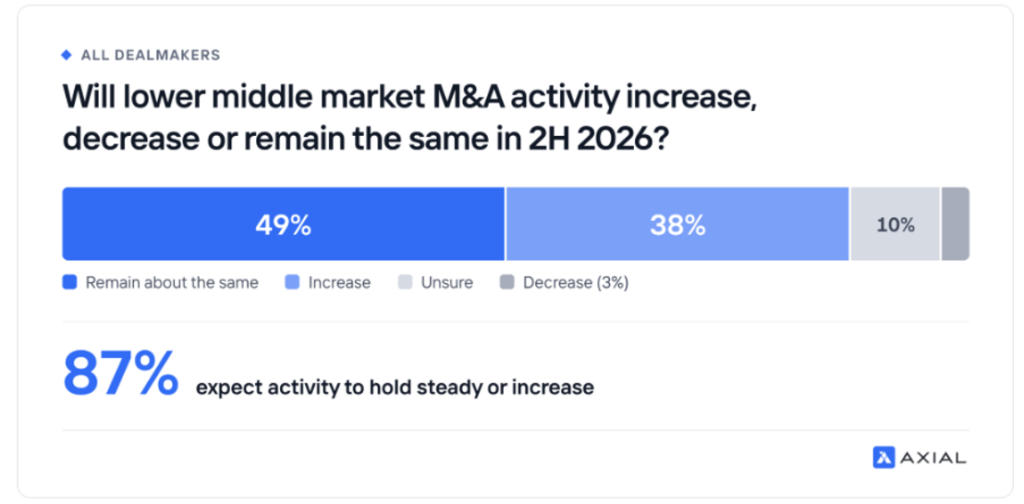
A combined 87% of dealmakers expect lower-middle-market M&A activity to either hold steady or increase during the second half of 2026, including 38% who expect activity to increase. Only 3% expect activity to decline. More importantly, this isn’t simply optimism expressed in a survey. Axial reported that 3,523 companies went to market on its platform during Q2 2026, the highest quarterly deal volume it has ever recorded and a 4.79% increase over the same quarter last year.
The technology numbers are even more interesting for those of us in this market. Technology had the largest year-over-year increase of any industry on Axial, with deal volume increasing 23.52%. Technology also ranked third among the seven major sectors in buyer pursuit rate. In other words, significantly more technology companies are coming to market, but there continues to be healthy buyer demand for those businesses as well.
For MSP owners in particular, that doesn’t surprise me. There continues to be a significant amount of private equity and strategic capital looking for good MSPs, and recurring revenue, strong margins, and predictable cash flow remain incredibly attractive to buyers. What has changed, in my opinion, isn’t buyers’ willingness to spend money. It is their willingness to spend premium money on an average company.
That helps explain what initially looks like a contradiction in Axial’s numbers. If deal activity is at record levels, buyer competition remains strong and we are seeing smaller MSPs achieve 10x multiples, why has valuation become the number one reason deals are failing? I think the answer is relatively simple. Buyers are willing to pay premium valuations for premium companies, but they aren’t necessarily willing to pay premium valuations for average companies.
An MSP owner may hear that a company with $1.6 million of EBITDA received a 10x valuation and understandably think that his or her company, with the same EBITDA, should be worth 10x as well. But buyers aren’t simply applying a multiple to an EBITDA number. Two MSPs generating exactly the same EBITDA can have very different values depending upon the quality and percentage of recurring revenue, organic growth, customer concentration, margins, retention, management depth, sales capabilities, and the degree to which the business remains dependent upon its owner.
There is another factor that I believe has an enormous impact on the final valuation as well, and that is competition. Talking to one buyer is not a competitive process, regardless of how attractive the initial offer may appear. When several qualified buyers are evaluating the company at the same time, they know they aren’t simply negotiating against the seller. They are competing against other buyers who want the same asset, and that can change the valuation dynamic considerably.
A buyer who initially believes 8x is a fair valuation may have to decide whether it is willing to pay 9x or 10x when it knows other serious buyers are at the table. This is why I continue to believe that sellers need to let the market tell them what their companies are worth rather than relying on one buyer to do it for them. The difference between those two approaches can translate into millions of dollars of additional value at closing.
The takeaway I get from Axial’s latest report is not simply that the M&A market remains strong. There are more companies coming to market, buyers remain active, technology deal flow is growing substantially, and competition for quality companies remains intense. Based on what I am seeing firsthand, I believe this continues to be an exceptionally strong market for well-run MSPs.
But a strong M&A market doesn’t guarantee a premium valuation. The MSPs getting those premium multiples are the ones giving buyers a reason to compete for them.
 What Buyers See That Most MSP Owners Miss