

Unless you have been living under a rock, I am sure you know by now that buyers will pay more for companies that have “recurring” revenue. But what about “repeat” revenue? And what really is the difference? Then, let’s not forget about “renewal” revenue and what value it may still have.
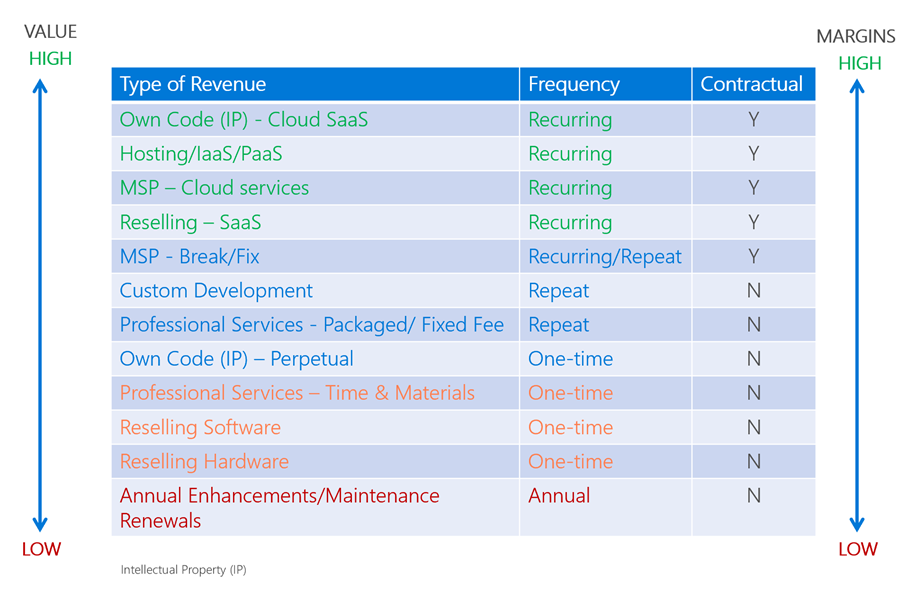
Below is a subset of a chart from my book Get Acquired for Millions: A Roadmap for Technology Service Providers to Maximize Company Value. The chart contains the 12 most common types of revenue you will find on the Income Statement of technology service providers.
The revenue types are organized by the most valuable and highest gross profit margin to the least valuable. The higher your revenue mix is on this chart, the more valuable your company is to a prospective buyer.
Let’s explain each more in detail:
Recurring revenue is typically revenue that is contractually bound by a legal agreement for a solution delivered by either a vendor or the partner organization over time. The items in green reflect the highest value of recurring revenue. Because this revenue is contractual over one or multiple years and may have penalties associated with it if the customer leaves, it is highly valued by prospective buyers because it can be counted on each year. Typically, with technology service providers, we see cloud solutions such as Email, ERP, CRM, Marketing automation, Ticketing systems along with other ISV solutions delivered on a monthly basis over a 12, 24- or 36-month contract. Canceling any of these typically incurs a hefty termination fee (assuming no uptime issues with the service level agreement).
Keep in mind, however, recurring revenue doesn’t have to be contractual to be valuable. For example, think about how a cloud-based CRM system collects customer data, emails, and transactions. Unless it is an “off-the-shelf” solution with no customizations, or unless the new provider is that much better than you, the potential cost of moving all the data to another vendor in the kind of format the customer requires can become such a burden that the customer is more or less locked in, even without a contract.
Repeat revenue on the other hand is revenue that typically happens every year but is not contractually bound on an annual basis. Custom developers are a great example of technology service providers who have a high amount of repeat revenue. Here there is typically no switching cost in terms of dollars, but the agony of trying to get another development team up to speed and integrated into the customers team can be difficult and time consuming. So, there is a sort of invisible contract that customers (unless they are super unhappy) don’t want to break, because the cost and time is too great to find a replacement.
To be clear, recurring revenue trumps repeat revenue every time (contractual or otherwise), but that doesn’t mean you cannot demonstrate the value of repeat revenue to a buyer. Two things will increase the value of repeat revenue: time as a customer and customer satisfaction scores. Tracking when you first acquired the customer is pretty easy for most companies, but many businesses don’t take the extra step of making sure that their customers are truly happy by tracking customer satisfaction scores. A buyer will have much more confidence in your repeat revenue if they can see that customers are pleased with your services. So be sure to track this annually, if not quarterly. Be on the lookout for any trends and spend the extra time creating case studies for your largest customers in order to show off the work you have done and the value the customer received from your team.
Finally there is renewal revenue, which unfortunately is the least valuable because there is no value-add by the provider – meaning all you are is the pass-through entity who is selling the maintenance plan and not the person actually supporting it. Many partner organizations like to call this repeat revenue because it does typically happen every year. And many organizations can count on as high as 95% customer maintenance renewal annually. However, the savvy buyer, doesn’t view it the same as it is typically the revenue with the least amount of gross profit margin (assuming its hardware or on-premise renewals). That said, I have seen many organizations now tie their own support plans to annual renewals and bill everything out on a monthly basis and bundle the entire solution into a monthly fee.
Here is an example: Let’s say the annual maintenance renewal for a company in December is $12,000 per year. The technology partner will bill the customer for the $12K, but then begin in January billing monthly (in advance) for not only the maintenance plan but an internal technical support plan as well. Let’s assume the value of the annual technical support plan is $10K. The entire $22,000 is then split over 12 months in equal installments. The provider has pre-billed the customer for the annual maintenance plan (which sits as a liability on the books until it is due to the software vendor) and they have also built in a monthly payment for the internally provided technical support plan and both become part of an annual contractually obligated support plan. The customer is happy, because now they don’t have a big payment due at the end of the following year and they now have support included on a fixed monthly fee. Buyers clearly like it because it has taken a maintenance renewal and turned it into a recurring revenue plan.
So, when you think about creating revenue streams in your business, be sure to always focus on recurring revenue, ideally contractually bound, but be thankful for any repeat revenue you can attract as well. If you really want to drive the value of your business through predictable and reliable recurring revenue, think about how you might make it harder for your customers to consider your competition and turn them into lifetime customers instead.
 Biden’s Election Doesn’t Mean You Have to Sell in 2020